Author: Kathleen Rea
Published in May 2023 and updated in November 2024
The “Dance” I am in service of…
I pause and lean into the dance
I wait, and there it is…
The moment of fall in our connected bodies
My body twists so I can follow the “landslide”
I extend my landing gear
and soften the tone in my back
Our backs stay connected
and I adjust slightly
so my fellow dancer falls over my centre
We are together in service of falling
bound by the laws of physics.
Contact Improvisation as a Dance of Service
I participate in both Ecstatic Dance and Contact Improvisation. In Ecstatic Dance, I am dancing on my own spot, shaking my body how I want as the music takes me on a crescendo of expression. Yes, I still need to be aware of community considerations. I need to dance and engage with the community in a way that does not prevent others from having their own cathartic experience. I would be taking away from their dance if, for example, I thrashed my arms around causing people to fear being hit or ran around the room bumping into people or screaming. So even in Ecstatic Dance, there is not complete freedom. But essentially, I show up to primarily experience my freedom to express myself.
Contact Improvisation however has an entirely different feeling for me. It is as if my partner and I have climbed on a surfboard traveling a wave. To do this well, we both need to be in humble service of the energies of the wave and each other’s movements. It requires heightened “listening” and co-attunement. If I started twisting my body and moving my arms in an expressive way just because I felt like it, I would likely fall off the surfboard into the water tumbling my partner down as I go. I still have personal expression on this surfboard, but I need to fit it in within my service to the wave, to the other person I am riding the wave with, and to the laws of physics that govern this co-relationship.
“The Dance”
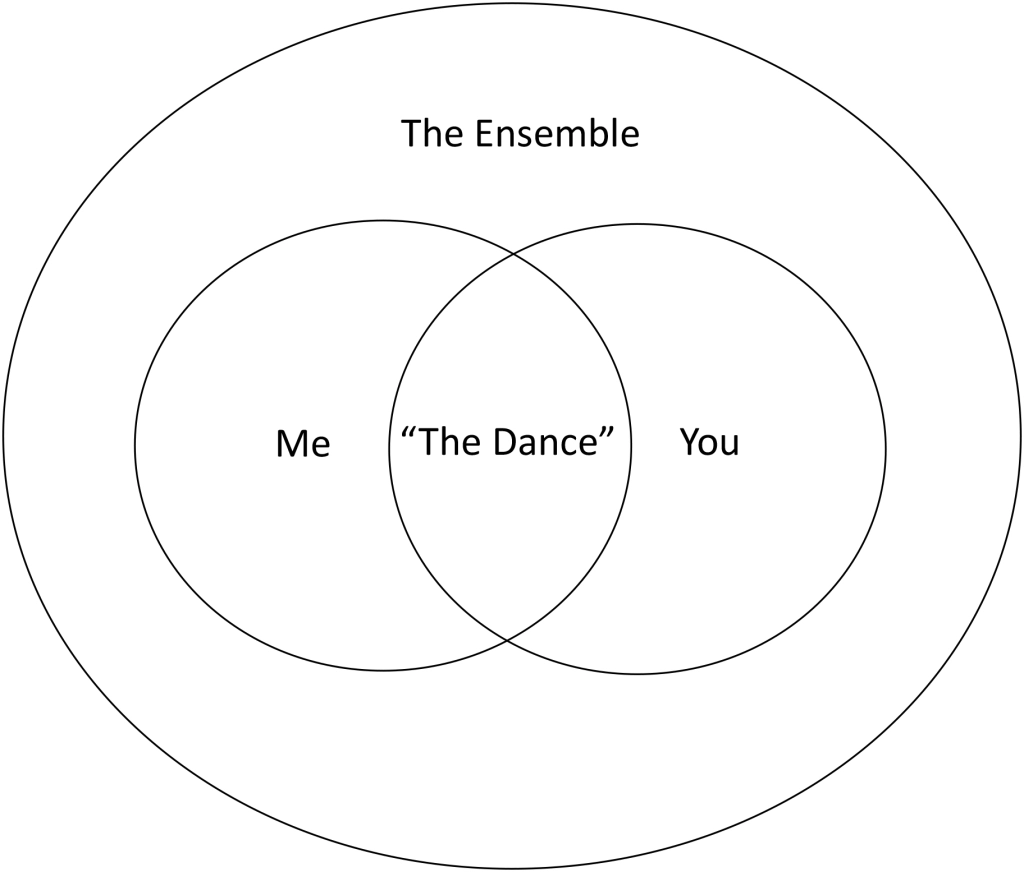
When I dance with another person, there is a feeling that our energies coalesce to create a third entity. I call this third entity The Dance. For me, The Dance is a liminal space created by dance partners co-following what is emerging between them. It is not me and is not you but instead it feels like its own thing. The Dance might want slow and introspective. It might want to be playful. It might want lots of space. I can say yes or no to The Dance. I can guide it somewhat, but I don’t get to choose The Dance because The Dance chooses itself. This act of service to The Dance can take me on a journey that may bore me, move me, amaze me, cause me to weep, be wild and energetic or take me into great moments of beauty, power, or fragility. I give up my freedom so that I can be contained in the service of co-creating.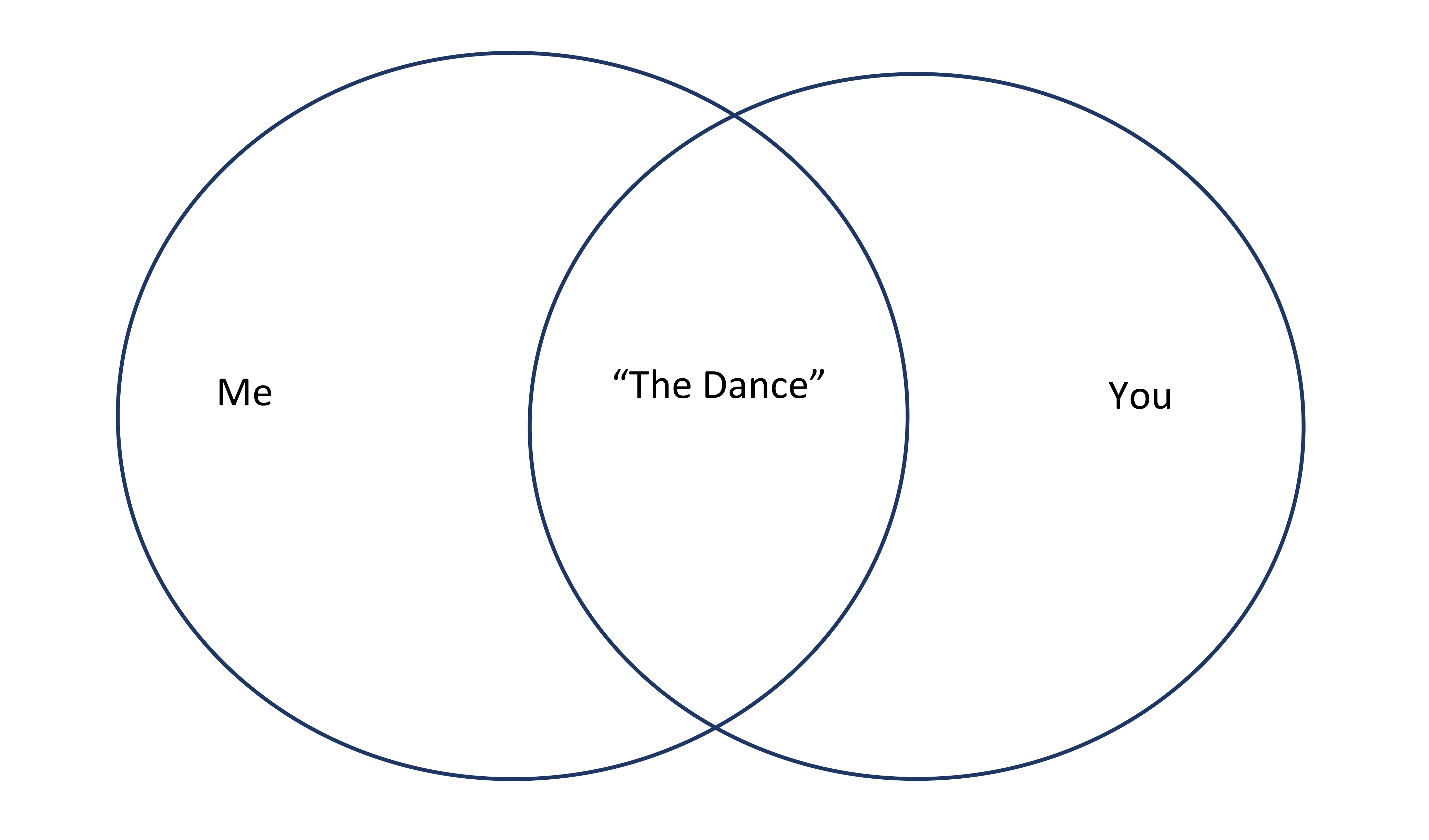
As partners, or trios or quartets, we can attend to The Dance that is emerging. To do this, I “listen” with my skin surface. I follow momentum created by our bodies. I work to make choices congruent with physics that aim towards ease. I use the just right amount and quality of muscle tone that optimally opens me up to responding. My landing gear and falling pathways are ready to be used at any moment. For me, it is an alert, present and humble state of being in which I can never fully surrender to myself or my desire for self-expression.
Contact Improvisation for me is not a freedom dance like Ecstatic Dance, but rather a dance of service. For me, while there is freedom “to” express in Contact Improvisation I work to fit this personal expression within the main goal of co-attuning and being with another. I also show up to attune to the group; to be part of an ensemble of people dancing together. At a contact improvisation jam I do not have the freedom to get lost in “the dance” as a part of me needs to be aware of and in service of the ensemble I am dancing with. I show up at a dance jam, to practice these acts of service and I never actually arrive at an “I-finished-learning-the-skillset” moment as it is a continuous never-ending practice.
“Freedom from” versus “freedom to”
In the article Freedom To vs. Freedom From by Sandro Galea (1), they explain that “Freedom From” occurs when you attain freedom from a pervasive issue or problem that has made your life hard or unhappy. When you go away on vacation you may experience “Freedom From” the slog of everyday life. A dancer attending a POC or women’s affinity jam might feel an increased “Freedom From” racism or misogyny that makes them feel on guard at regular dance jams.
“Freedom To” is a different type of freedom and is about what you are free to do. An example is, the “Freedom To” carry guns that is part of US culture. “Freedom From” and “Freedom To” can be in conflict when they intersect. Gun culture in the US is an example of this. If people want “Freedom From” the reality and fear of mass shootings, then the “Freedom To” carry guns might need to be taken away or amended. In this case, “Freedom To” interferes with “Freedom From”.
As a former ballerina, I felt “Freedom From” in the first few moments I did CI. It blasted through my soul like nothing else ever had. I rejoiced in a feeling of coming home to my body in a way that was not painfully pulling apart my joints. I was free to surf momentum rather than make calculated movements through sheer will and muscle power. I was free “From” worrying about my aesthetic form because generally, people at jams do not care what the dance looks but rather how the dance feels. After twenty years of looking in the mirror to correct my ballet form, this was a liberation for me. The platonic intimacy I experienced in Contact Improvisation was “Freedom From” relationship norms that place all the touch needs onto one person who was my partner.
But not all people feel “Freedom From” when doing Contact Improvisation to the same degree that I did, or even at all. Pervasive societal issues such as racism, misogyny, and ableism in the broader culture show up on the dance floor. For example, while Contact Improvisation gave me much “Freedom From” the tight constraints of the ballet world, it did not give me “Freedom From” misogyny, sexism, and ableism in our society that show up on the dance floor.
One’s life story dictates how much “Freedom From” they will feel when they start learning contact improvisation. For example the “Freedom From” I experienced was because of where I was coming from. If prior to starting Contact Improvisation, someone has been doing Ecstatic Dance for twenty years rather than classical ballet, they might experience Contact Improvisation differently then I did. They might feel constricted by being called upon to give up some personal expression to enter a space of co-creation. Similarly, this can occur for some people whom society affords power and privilege to. They might be so used to walking through life without needing to “read” others or adjust themselves in co-relationship with others that being called upon to do so in Contact Improvisation spaces can feel like a painful reduction of their personal freedom.
I also wonder if people experiencing an exhilarating and ground-breaking “Freedom From” in Contact Improvisation such as I experienced when I first found the form risk thinking that the driving force in the dance form is freedom. I worry that this can create a confusion about what the form is about that can create community issues.
In my role as a jam facilitator, I once had two men corner me as I packed up from my jam, yelling at me “You’re taking away my freedom with your guidelines”. I had created consent-based jam guidelines stating expectations for behaviors to create a dance jam where people could experience increased “Freedom From” unwanted touch and predatory behaviors.
Did these two men expect uninhibited “Freedom To” on the dance floor alongside “Freedom From” needing to think about consent? This story represents intersecting “Freedom From” needs. These two men wanted “Freedom From” needing to think about consent while many women and non binary peoples wanted a higher level of consent culture so they would have increased “Freedom From” unwanted touch on the dance floor. I am curious if the idea of contact improvisation as a dance of service rather than a “Freedom” dance might have helped these men better adapt to the dance jam guidelines?
If you are coming to a Contact Improvisation jam expecting or looking for “Freedom To” express and “Freedom To” be, then you might be in the wrong place. In this mindset, your initial reaction might be anger when a jam facilitator comes up to you and says, “Hey… remember the guidelines” or “remember to lift using momentum rather than muscle power”, or, “let’s talk about consent” or “let’s talk about the effect you are having on the ensemble” you may feel like your freedom is being taken away. You may even go into attack mode to defend your “Freedom To”. But from the perspectives I have presented here, perhaps “Freedom To” is not inherent in the form. Pulling back from pure self-expression and a desire to fulfil one’s own needs means there is space to move in service of cocreation… in service of The Dance.
Contact Improvisation is not codified. There isn’t one definition of what it is or what it should be and instead just different people’s views. This idea of Contact Improvisation being a dance of service is just my idea. I offer that you try on this idea and see how it fits… see what happens when you move in service of The Dance.
References:
Galea, S. (2017). Freedom “to” Vs. Freedom “from. BU School of Public Health. Downloaded on May 12, 2023 at https://www.bu.edu/sph/news/articles/2017/freedom-to-vs-freedom-from/
 Contact Improv Consent Culture: Building consent-based culture
I love this Kathleen. Thank you.
LikeLike